Salesforce’s “Simplification” Playbook: The Uninvited Bundle and the Real Math Behind Core, Advanced, and Max
Salesforce has officially launched a major overhaul of its CRM editions, renaming and repackaging its flagship Sales and Service portfolios into Core, Advanced, and Max. The marketing narrative is standard enterprise SaaS fare: a cleaner catalog, all-in-one AI bundles, and claims of delivering "up to 70% more value". In enterprise procurement, however, when a vendor like Salesforce announces it has "simplified" its packaging, it usually means your bill is about to get more expensive. Maybe not now, but certainly in the near future. If we go back Salesforce's retiring of Performance Edition (what effectively became the now retired Unlimited ...
Read More
Anthropic: The $2 Trillion Vendor You Already Standardized On
Anthropic is heading toward the largest IPO in history on a growth curve investors are underwriting....not one the company has guaranteed. Enterprise buyers who've built on Claude are exposed to that gap whether or not they own a share of stock. Anthropic's last private valuation was $965 billion, set in a $65 billion Series H round in May 2026. Six investors have told the Financial Times to expect the company to seek $2 trillion or more when it lists, reportedly as soon as October 2026, which would more than double that mark in a matter of months and surpass SpaceX's record-setting $1.77 trillion June debut as the largest IPO ever ...
Read More
NVIDIA Bought the Town Square of Open AI, And Told Everyone Not to Worry About the Fence
NVIDIA has agreed to acquire Hugging Face for $12.9 billion — the closest thing the AI industry has to neutral ground. The deal isn't closed yet, it faces a genuine antitrust gauntlet, and the company that owns roughly three-quarters to nine-tenths of the AI chip market now also owns the platform where the rest of the industry discovers, evaluates, and ships its models. NVIDIA confirmed on September 3, 2026 that it has agreed to acquire Hugging Face, the platform that hosts three million models, half a million datasets, roughly a million applications, and the discovery layer used by over 18 million developers and 200,000-plus companies. ...
Read More
Snowflake: The $4.7 Billion Data Tax You Keep Paying for the Privilege of Not Leaving
Snowflake's growth chart looks incredible if you're an investor. Customers should be asking a more uncomfortable question. Analysis of Snowflake's cost structure & switching-cost economics Revenue climbing toward $5–6B+, product gross margins in the low-to-mid 70s on a non-GAAP basis (GAAP total gross margin hovering around 67%), net revenue retention still north of 125%, and AI features now juicing consumption enough to keep the acceleration narrative alive. Wall Street loves the story. Customers should be asking a more uncomfortable question: are we funding a product, or are we funding a high-margin rent extraction machine that keeps ...
Read More
The Seat Is Dying: AI Agents Are Rewriting Software Pricing
For decades, enterprise software pricing was built around a familiar unit: the human being. Count the employees, identify the users, negotiate the per-seat price and then spend the next three years discovering that 17 percent of those users never logged in. It was not perfect, but at least everyone generally understood what was being purchased. AI agents are beginning to dismantle that model. Unlike a traditional user, an AI agent may complete thousands of actions, interact with multiple systems and operate continuously without taking lunch, vacation or an inexplicable three-hour block marked “focus time.” Vendors are now trying to determine ...
Read More
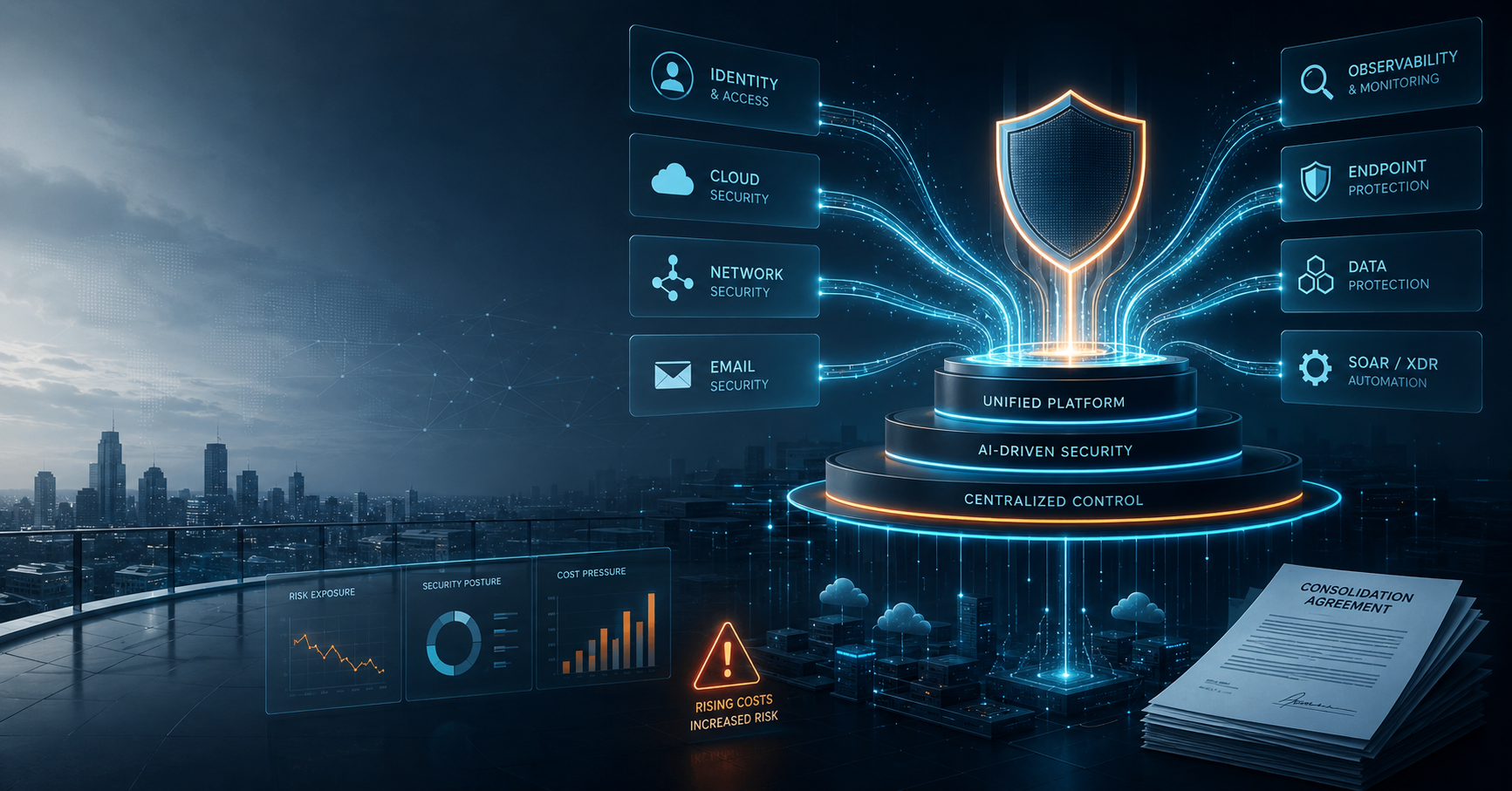
The Cybersecurity Superplatform Land Grab What Palo Alto Networks’ Reported Interest in Datadog and Okta Could Mean for Enterprise Buyers
What Palo Alto Networks’ Reported Interest in Datadog and Okta Could Mean for Enterprise Buyers A recent report from The Information revealed that Palo Alto Networks CEO Nikesh Arora explored potential acquisitions of Datadog and Okta. There is no confirmed or pending transaction involving either company, and the reported discussions may never produce one. Still, the names themselves are noteworthy. Datadog is a major observability platform, while Okta is one of the most recognizable identity and access management providers. Either would extend Palo Alto Networks much further into the daily operations of enterprise technology. The broader ...
Read More
The Cloud Concentration Trap: Why Non-Standard Tech Stacks Can Strengthen Resilience and Commercial Leverage for Banks
For the better part of a decade, the financial services industry has moved to a familiar beat: migrate core banking workloads, real-time settlement capabilities, and risk analytics to public cloud hyperscalers. Many tier-1 institutions now depend heavily on a very concentrated group of providers, primarily Amazon Web Services (AWS), Microsoft Azure, and Google Cloud Platform (GCP). That shift has delivered real benefits in speed, scalability, and access to innovation. But its also created a less comfortable reality: technology concentration. When many institutions rely on similar cloud control planes, DNS services, identity layers, and ...
Read More
Independent Advice Is Becoming an Endangered Species
There was a time when the technology advisory market had a healthy population of independent specialists. These firms focused on a specific mission: helping clients select technology, optimize licensing, benchmark pricing, negotiate agreements and manage supplier relationships. They did not necessarily want to implement the system, resell the software, manage the environment or turn the initial project into a five-year transformation program. They were paid to advise the client and or save them money. Increasingly, those firms are disappearing into larger consulting, outsourcing, software-resale and technology-services organizations. Some of ...
Read More
The SaaS Visibility Crisis: Shadow AI Is Making Shadow IT More Expensive
Shadow IT is hardly a new problem. Employees have been downloading unapproved applications since someone first realized they could avoid an IT service ticket by entering a credit card number. Generative AI has made the problem faster, easier and considerably more complicated. Today, an employee does not need to implement a major software platform to create a new technology expense or expose company information. They can subscribe to an AI assistant, connect a browser extension, authorize a plug-in or activate an AI feature already embedded in an existing SaaS product. The entire “implementation” might take less time than it takes to find the ...
Read More
Workday’s New Pricing Puzzle: APIs, AI Agents, and Success Plans
When we first examined Workday Flex Credits, the primary concern was straightforward: would consumption-based AI pricing provide flexibility, or become another budget line that is easy to buy and difficult to predict? Recent experiences suggest the issue is becoming broader. NET(net)’s specialists are seeing three commercial areas increasingly overlap: API consumption, AI agents, and Workday Success Plans. Each can affect the others, making it difficult to evaluate a proposal one line item at a time. Our earlier article on Workday Flex Credits explored the potential risks of buying AI capacity before adoption is fully understood. Since then, ...
Read More



.png?width=24&height=24&name=icons8-twitter-24%20(1).png)