

.png?width=24&height=24&name=icons8-twitter-24%20(1).png)


Anthropic is heading toward the largest IPO in history on a growth curve investors are underwriting....not one the company has guaranteed.
Enterprise buyers who've built on Claude are exposed to that gap whether or not they own a share of stock.
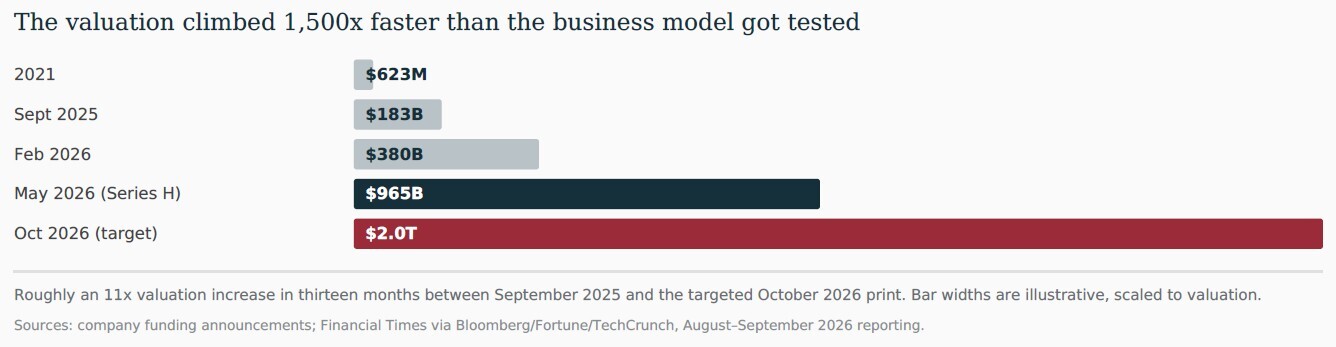
Anthropic's last private valuation was $965 billion, set in a $65 billion Series H round in May 2026. Six investors have told the Financial Times to expect the company to seek $2 trillion or more when it lists, reportedly as soon as October 2026, which would more than double that mark in a matter of months and surpass SpaceX's record-setting $1.77 trillion June debut as the largest IPO ever attempted. Anthropic's own annualized revenue run rate crossed roughly $65 billion in July, up from about $9 billion at the end of 2025. Investors are underwriting a further jump to $100–120 billion by December to justify the $2 trillion figure.
None of that is in dispute. What's worth sitting with, before the roadshow narrative sets in, is what enterprise buyers are actually being asked to underwrite alongside Wall Street:
-
A company whose growth curve depends on capacity it has already reserved but not yet paid for at scale.
-
Whose flagship model costs multiples of its nearest competitor.
-
With access that can be shut off by a regulator's letter with zero notice (as already happened once this year for eighteen days).
The math no one wants to sit with.
A $2 trillion print requires public markets to price in a jump from roughly $65 billion in annualized revenue in July to $100–120 billion by December, a 2 to 2.5x move in five months, on the strength of investor modeling, not company guidance. No senior Anthropic executive has confirmed a $2 trillion target even privately, according to the same reporting. That gap between "what bankers are underwriting" and "what the company has said" is the first thing that should give a buyer pause, because it means the valuation your vendor carries into a renewal negotiation next year is a number the market invented on its behalf.
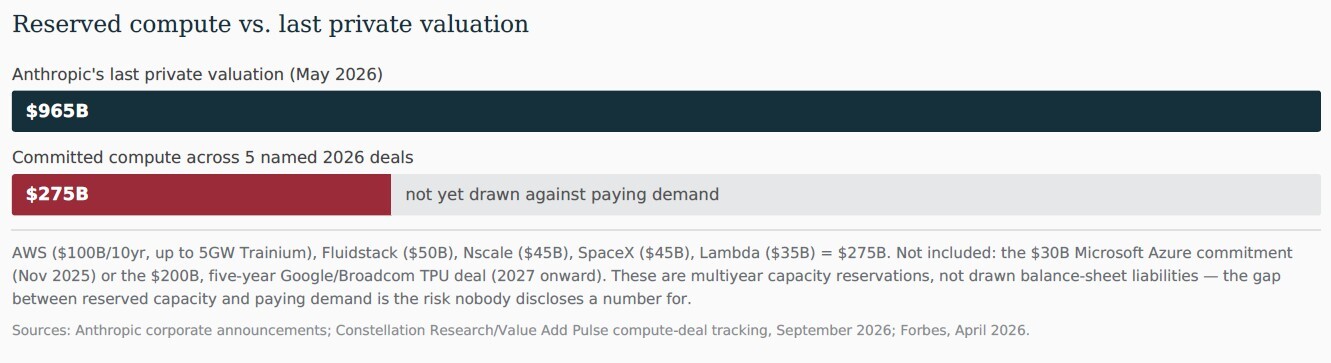
What the buyer is actually financing: $275B in capacity with no disclosed utilization rate.
Since the spring of 2026, Anthropic has signed five multibillion-dollar compute contracts with AWS, Fluidstack, Nscale, SpaceX, and Lambda - that together commit more than $275 billion in reserved cloud capacity, on top of the earlier $30 billion Microsoft/Azure commitment and a $200 billion, five-year Google/Broadcom TPU partnership. That's close to 30% of Anthropic's own $965 billion private valuation in take-or-pay capacity reservations for a company that only began showing operating-income profitability signals this year.
THE CIRCULARITY QUESTION
Anthropic's own backers - Amazon, Google, Microsoft, Nvidia - are simultaneously its cloud landlords, chip suppliers, and equity investors. Anthropic CEO Dario Amodei has defended this structure directly: "
"One player has capital and has an interest, because they're selling the chips, and the other player is pretty confident they'll have the revenue at the right time, but they don't have $50 billion at hand. So I don't think there's anything inappropriate about that in principle."
Critics, and Nvidia's own CEO, on the other side of the argument, compare the pattern to late-1990s telecom vendor financing, where supplier-funded demand looked like revenue....until it didn't. Anthropic is not unique in running this playbook; OpenAI's arrangements with Nvidia, Microsoft, and Oracle draw the same scrutiny. But it means a chunk of the revenue growth justifying a $2T print flows through the same handful of counterparties financing the capacity that generates it.
Price and dependency: the bill an enterprise buyer actually sees.
THE QUESTION A $2T PUBLIC COMPANY CAN'T AVOID ASKING
A private Anthropic can afford to hold pricing flat to keep enterprise adoption climbing into the IPO. A public Anthropic, carrying a valuation built on hitting $100–120 billion in revenue by December and $190–$200 billion by 2028, faces quarterly earnings pressure the day it lists, and pricing is the fastest lever available to close a revenue gap.
If Claude's premium over competing frontier models moves from 2.5x to 3x or higher to help the numbers work, the real question for every enterprise buyer isn't whether Anthropic can raise prices. It's whether Claude is still worth it at that price when a comparable model is available for a fraction of the cost. That's a harder conversation to have after two years of production workloads, prompts, and evaluation pipelines are already built around Claude than it is today.
The regulatory kill switch is not hypothetical.
On June 12, 2026, three days after launch, the U.S. Commerce Department ordered Anthropic to suspend global access to its two most capable models, Fable 5 and Mythos 5, citing national security authorities and a "foreign national" access restriction Anthropic had no technical way to enforce selectively.
Anthropic took both models offline worldwide, for every customer, U.S. and foreign alike, including reportedly for the NSA. Access was restored on July 1 after an 18-day suspension, following government approval. Investors who shared projections with the Financial Times confirmed Anthropic's growth slowed measurably during that window, the first time a U.S. frontier AI lab has had specific models pulled offline globally on national-security grounds.
WHY THIS MATTERS TO A PROCUREMENT TEAM, NOT JUST A TRADER
This wasn't a vendor outage or an SLA breach with a contractual remedy. It was a legally binding directive that overrode Anthropic's own product roadmap and its customers' contracts with zero advance notice. Enterprises running mission-critical workloads on frontier-tier Claude models absorbed the suspension the same way Anthropic's shareholders did - instantly, and with no recourse written into any commercial agreement anticipating it.
The Contrarian Bottom Line
Claude is a genuinely strong product, and Anthropic's decision to distribute across all three major hyperscalers, rather than embed itself in one, the way Snowflake embeds a customer in its Data Cloud, is a real point in its favor over the lock-in stories NET(net) has flagged in other vendors. That distribution strategy is the one part of this picture that looks more buyer-protective than most enterprise software relationships, not less.
But a $2 trillion IPO asks public markets, and by extension the enterprise customers whose spend is the growth story, to accept three things simultaneously: revenue projections built by bankers rather than guided by the company; a compute cost base reserved years ahead of the demand meant to justify it, financed substantially by the same companies that supply and consume it; and a demonstrated willingness of the
U.S. government to suspend the company's frontier models worldwide without warning. Any one of those is a manageable vendor-risk line item. Underwriting all three into a record-setting valuation, while enterprise buyers are underwriting the same vendor into their own roadmaps, is the pattern worth naming before the roadshow locks in the narrative.
Top 5 Ways Enterprise IT Buyers Should Respond
01 - Separate your model contract from the IPO narrative
Negotiate pricing, capacity, and SLA terms against Anthropic's current commercial performance, not against a $2 trillion valuation story built by underwriters. A public listing changes reporting obligations and investor pressure, not the terms you signed.
02 - Build a genuine multi-model fallback, not a theoretical one
The June 2026 export-control suspension proved a frontier-model outage can happen with zero notice and no contractual remedy. Maintain a tested, current path to at least one alternate frontier model for anything mission-critical - not a stale architecture diagram from last year's vendor review.
03 - Stress-test your workload at 3x today's price, not just today's price
Anthropic's per-token cost already sits well above competing frontier models before a single earnings call. Model what your Claude spend looks like if the post-IPO pricing lever gets pulled to help hit analyst targets, and decide now — not after two years of prompts and pipelines are built around it - whether the answer is still yes.
04 - Ask where your vendor's compute actually comes from
Anthropic's capacity is spread across AWS, Google/Broadcom, Microsoft/Nvidia, Fluidstack, Nscale, SpaceX, and Lambda. Diversified supply is a genuine strength — but also means a shock to any one of those counterparties' balance sheets is now indirectly your supply-chain risk too. Ask your rep which contracts are live capacity versus future reservations.
05 - Track the post-IPO pricing and disclosure signals, not the debut headline
A public Anthropic will face quarterly pressure to show revenue quality separate from vendor-financed or circular compute arrangements. Watch gross margin, customer concentration disclosures, and any pricing moves in the two to three quarters after listing — that's when a $2T valuation either gets defended with real numbers or starts correcting.
The honest caveat: the $2 trillion figure is investor chatter reported by six backers to the Financial Times, not a company-confirmed target, and Anthropic's multi-cloud distribution strategy is a materially better buyer posture than the single-platform lock-in this series has flagged in other vendors. This is a company with real revenue growth and a real product advantage in enterprise coding and agentic workflows. The risk isn't that Anthropic is a bad vendor, it's that the valuation being built around it prices in a growth and stability story that enterprise buyers, not just IPO investors, are being asked to make true.
Sources: Financial Times reporting via Bloomberg, Fortune, TechCrunch, Gizmodo, and Forbes on Anthropic's IPO plans and valuation targets (Aug–Sept 2026); PYMNTS on investor targets and pricing pressure (Sept 2026); Value Add Pulse / Constellation Research on Anthropic's 2026 compute-contract tracking; Anthropic corporate announcements (Google/Broadcom, Microsoft/Nvidia partnerships); CNBC, Nextgov/FCW, Forbes, and PIIE on the June 2026 Fable 5/Mythos 5 export-control suspension; TechTimes on the IPO-timeline impact of the export ban; G2 product reviews; Bloomberg, Axios, and BlockEden.xyz on AI circular-financing dynamics; Dario Amodei remarks, NYT Dealbook Summit, December 2025; Fortune/AOL on Bank of England and Michael Burry bubble commentary (Dec 2025); The Motley Fool valuation analysis (Sept 2026); Planet Earth & Beyond (Substack) contrarian commentary (Sept 2026); Beri.net / TechTimes on Anthropic's July 2026 enterprise spend-control rollout and reported customer overspend incidents; Kosmoy on multi-vendor AI lock-in mechanisms (July 2026); Hacker News discussion thread on Anthropic IPO economics (Aug 2026); Quora community response, Claude vs. ChatGPT (2026).
About NET(net)
At NET(net), we don't just optimize IT investments, we weaponize them for competitive advantage. As the world's leading technology investment optimization firm, we've spent over two decades perfecting the art and science of extracting maximum value from technology supply chains while neutralizing vendor pricing manipulation.
Our battle - hardened methodology has influenced trillions of dollars in technology investments, captured hundreds of billions in documented value, and transformed how enterprises approach every facet of IT spend - from emerging technology such as AI, ML, IoT, RPA, Quantum, and Blockchain, to IaaS, PaaS, and SaaS, to enterprise hardware and software solutions, and professional services arrangements including strategic outsourcing relationships.
We're not consultants who theorize about optimization, we're the specialists who help you devise and execute your strategy. Our proven frameworks turn vendor pricing chaos into strategic opportunity, licensing complexity into competitive advantage, and cost centers into value engines. Whether you're facing an aggressive vendor audit, navigating a forced migration, or simply refusing to accept runaway IT costs, NET(net) delivers the expertise, experience, and execution you need to dominate rather than merely survive.
Founded in 2002, NET(net) has established itself as the essential strategic partner for enterprises and technology providers who demand performance, not promises. We've mastered every major area of IT optimization because we understand that in today's vendor-hostile environment, half-measures guarantee defeat.
Experience the NET(net) advantage. Contact us at info@netnetweb.com, visit www.netnetweb.com, or call +1 (616) 546-3100 to discover how we can transform your technology investments from cost burden to strategic weapon.
Legal Disclaimer: NET(net)'s website, blogs, articles, and other content are subject to NET(net)'s legal terms and are offered for general information purposes only, and do not constitute legal advice. While NET(net) may offer views and opinions regarding the subject matter, such views and opinions are those of the content authors, are not necessarily reflective of the views of the company, and are not intended to malign or disparage any other company or other individual or group. Visit our legal notice page for more information.